
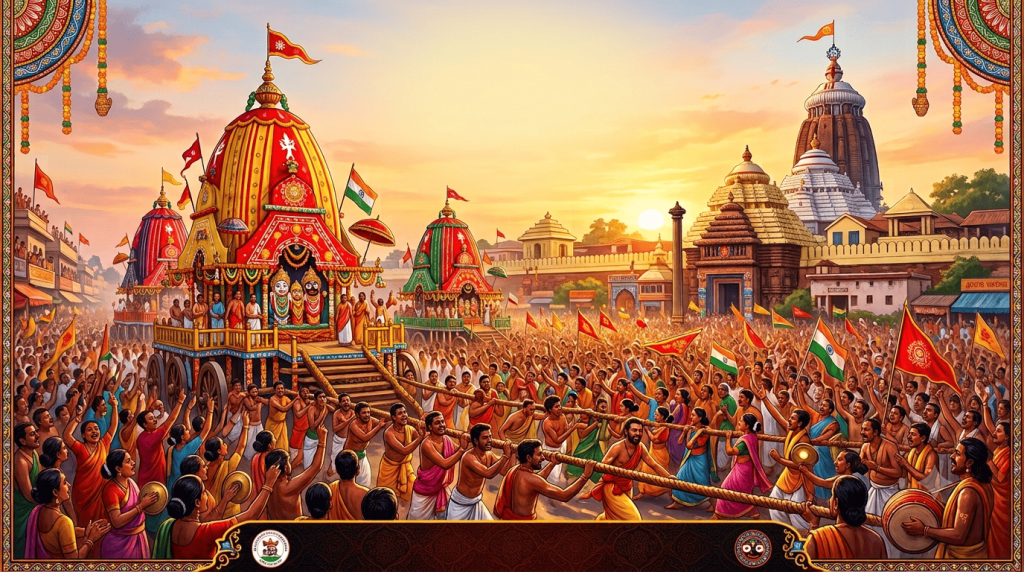
Jagannath Rath Yatra 2026: History, Rituals & Travel Guide
11 July 2026 by admin

Jagannath Rath Yatra 2026: History, Rituals & Travel Guide
Introduction
Jagannath Rath Yatra is one of India’s most sacred and spectacular Hindu festivals. Every year, millions of devotees gather in Puri, Odisha, to witness the divine procession of Lord Jagannath, Lord Balabhadra, and Goddess Subhadra as they travel from the Jagannath Temple to the Gundicha Temple on beautifully decorated wooden chariots.
Jagannath Rath Yatra is a unique festival in which the deities come out of the temple to bless devotees. The procession represents the belief that God is accessible to people of every caste, religion, nationality, and social background.
Devotees celebrate the festival with devotional chants, kirtans, traditional music, and great enthusiasm. They consider pulling the sacred chariot an act of immense spiritual merit that brings blessings, removes sins, and leads toward liberation (Moksha).
This guide explains the history, spiritual significance, rituals, and travel tips for Jagannath Rath Yatra 2026. It is a valuable resource for pilgrims, devotees, and anyone interested in India’s rich spiritual heritage.
What is Jagannath Rath Yatra?
Jagannath Rath Yatra is the annual Chariot Festival dedicated to Lord Jagannath, a revered form of Lord Vishnu (Krishna). During the festival, Lord Jagannath, Lord Balabhadra, and Goddess Subhadra leave the sanctum of the Jagannath Temple and travel about three kilometers to the Gundicha Temple in magnificent wooden chariots.
The sacred journey represents Lord Jagannath’s visit to His birthplace and His blessings for devotees who cannot enter the temple.
Jagannath Rath Yatra ranks among the world’s oldest continuously celebrated religious festivals. Every year, it draws millions of pilgrims and tourists to Puri.
History of Jagannath Rath Yatra
The origins of Jagannath Rath Yatra date back more than a thousand years. Historical records indicate that the festival has been celebrated since the 12th century. The tradition itself is believed to be much older.
King Anantavarman Chodaganga Deva of the Eastern Ganga Dynasty commissioned the construction of the present Jagannath Temple in Puri during the 12th century. Rath Yatra became one of India’s largest and most revered religious festivals.
The Skanda Purana, Brahma Purana, Padma Purana, and Narada Purana describe Lord Jagannath’s divine journey and highlight the spiritual benefits of participating in or witnessing the festival.
Over the centuries, Jagannath Rath Yatra has grown into an international celebration. Devotees in the United States, the United Kingdom, Australia, Canada, Russia, and many other countries celebrate Jagannath Rath Yatra through temples and spiritual organizations.
The Legend Behind Jagannath Rath Yatra
Several legends describe the origin of Jagannath Rath Yatra.
One popular belief says that Lord Krishna wished to visit His birthplace and relatives with His elder brother, Lord Balabhadra, and sister, Goddess Subhadra. Their annual journey commemorates this sacred visit.
Another tradition tells of Queen Gundicha inviting Lord Jagannath to visit her temple every year. Lord Jagannath accepted the invitation, leading to the annual procession from the Jagannath Temple to the Gundicha Temple.
A Vaishnava tradition links the festival to Lord Krishna’s journey from Dwarka to Vrindavan. The journey represents His eternal love and compassion for His devotees.
These legends highlight devotion, compassion, and divine grace. They have made Jagannath Rath Yatra one of the most revered and celebrated festivals in Hinduism.
Who is Lord Jagannath?
Lord Jagannath is regarded as a universal form of Lord Vishnu and Lord Krishna. The word “Jagannath” means “Lord of the Universe.”
The deities at Jagannath Temple are carved from sacred neem wood (Daru Brahma). The sacred ritual of Nabakalebara marks the ceremonial replacement of the wooden idols with newly carved and consecrated ones at specific intervals.
Lord Jagannath’s large, round eyes symbolize His eternal watchfulness over all living beings. His distinctive form represents the limitless nature of the Divine beyond ordinary human appearance.
For millions of devotees, Lord Jagannath represents unconditional love, compassion, equality, and divine protection.
Lord Balabhadra and Goddess Subhadra
Lord Balabhadra
Balarama or Lord Balabhadra, is the elder brother of Lord Jagannath. He represents strength, righteousness, courage, and agricultural prosperity. During Rath Yatra, He travels in the magnificent Taladhwaja chariot.
Goddess Subhadra
Goddess Subhadra is the sister of Jagannath and Balabhadra. She symbolizes divine compassion, harmony, and maternal blessings. She rides in the Darpadalana chariot during the procession.
The presence of all three siblings makes Jagannath Rath Yatra a unique celebration of family, unity, and divine love.
Spiritual Significance of Jagannath Rath Yatra 2026
Jagannath Rath Yatra is a sacred festival that inspires devotion, humility, and unity. It holds deep spiritual significance for millions of devotees.
1. God Comes to the Devotees
Most Hindu temples require devotees to visit the deity. During Rath Yatra, however, the Lord Himself comes out of the temple to bless everyone. This symbolizes that divine grace reaches every soul, irrespective of background or status.
2. Equality and Inclusiveness
Rath Yatra carries a powerful message of equality. People from all communities join together to pull the chariots, expressing the belief that everyone is equal before the Lord.
3. Path to Moksha
Hindu scriptures describe witnessing or participating in Jagannath Rath Yatra with sincere devotion as a path to purifying the mind, removing accumulated sins, and progressing toward spiritual liberation.
4. Symbol of Life’s Journey
The moving chariots represent the journey of human life. Devotees pull the Lord’s chariot with faith and dedication. The sacred act inspires people to lead their lives with righteousness, devotion, and selfless service.
5. Celebration of Bhakti
The festival highlights the power of devotion through bhajans, kirtans, chanting, seva, and collective worship. It reminds devotees that sincere love for God is the highest form of spiritual practice.
Why Jagannath Rath Yatra is Famous Worldwide
Today, Jagannath Rath Yatra is celebrated across the globe. Cities in the United States, the United Kingdom, Canada, Australia, South Africa, Singapore, and many other countries organize grand chariot festivals inspired by the Puri tradition.
The festival attracts devotees, historians, photographers, travelers, and culture enthusiasts who come to experience its vibrant atmosphere, intricate rituals, and deep spiritual significance.
Its universal message of love, equality, and devotion has made Jagannath Rath Yatra one of the world’s most recognized Hindu festivals.

Complete Timeline of Jagannath Rath Yatra
The Rath Yatra is not just a one-day event. The festival includes a series of sacred rituals over several weeks. Each ritual holds deep spiritual significance.
1. Akshaya Tritiya – Beginning of Chariot Construction
The preparations begin on Akshaya Tritiya, an auspicious Hindu festival.
On this day:
- Construction of the three giant wooden chariots begins.
- Special neem wood is brought from designated forests.
- Traditional temple carpenters start building the chariots using centuries-old techniques.
- Interestingly, no nails are used in many structural joints, preserving ancient craftsmanship.
Temple artisans build brand-new chariots every year instead of reusing old ones. This tradition makes Jagannath Rath Yatra unique among Hindu festivals.
2. Snana Purnima
Snana Purnima takes place about fifteen days before Jagannath Rath Yatra and is one of the festival’s most important rituals.
During this ceremony:
- Temple servitors bring Lord Jagannath, Lord Balabhadra, and Goddess Subhadra out of the sanctum.
- They ceremonially bathe the deities with 108 sacred pots of water.
- Devotees receive a rare public darshan.
Snana Purnima offers one of the few opportunities to see the deities outside the temple before Jagannath Rath Yatra.
3. Anasara (Anavasara)
After the ceremonial bath, it is believed that the deities develop a fever.
For approximately 15 days:
- Public darshan remains closed.
- The deities rest inside the temple.
- Temple priests offer herbal medicines and special food.
- Artists repaint and restore the wooden idols.
This period symbolizes divine humanity, reminding devotees that even the Lord participates in earthly experiences.
4. Netrotsava (Nava Jaubana Darshan)
Before Rath Yatra begins, a special ritual called Netrotsava takes place.
During this ceremony:
- The eyes of the deities are ceremonially repainted.
- Their youthful appearance is restored.
- Devotees receive the first darshan after the Anasara period.
This marks the spiritual “rebirth” of Lord Jagannath before His annual journey.
5. Pahandi Bije
On the day of Rath Yatra, the deities are carried out of the temple in a grand procession known as Pahandi.
Highlights include:
- Thousands of servitors carry the deities.
- Devotional music fills the streets.
- Conch shells, cymbals, drums, and chants create an electrifying atmosphere.
- Devotees chant:
“Jai Jagannath!”
The rhythmic movement of the deities during Pahandi is one of the most emotional moments of the festival.
6. Chhera Pahanra
One of the most remarkable rituals is Chhera Pahanra.
The Gajapati King of Puri performs this sacred ceremony by:
- Sweeping the chariot floors.
- Using a golden broom.
- Sprinkling sandalwood water.
This ritual symbolizes that before God, every individual is equal, regardless of wealth, status, or power.
It is considered one of the most powerful messages of humility in Hindu tradition.
7. The Grand Rath Yatra
The massive wooden chariots begin their journey to the Gundicha Temple after the Chhera Pahanra ritual.
The route covers approximately 3 kilometers. Millions of devotees pull the chariot ropes, and the procession often takes several hours to reach its destination.
Millions of pilgrims gather to witness this sacred annual event.
Many devotees believe that touching the chariot ropes brings divine blessings.
8. Stay at Gundicha Temple
After reaching Gundicha Temple:
- Lord Jagannath remains there for about seven days.
- Daily rituals continue.
- Thousands of pilgrims visit for darshan.
- The atmosphere remains festive throughout the week.
Many devotees consider this period one of the most spiritually rewarding times to visit Puri.
9. Bahuda Yatra (Return Journey)
After seven days, the deities return to the Jagannath Temple.
This return procession is called Bahuda Yatra.
Although it follows the same route, the celebrations are equally grand, attracting another massive gathering of devotees.
10. Suna Besha (Golden Attire)
Perhaps the most visually stunning ritual is Suna Besha.
During this ceremony:
- Lord Jagannath
- Lord Balabhadra
- Goddess Subhadra
are adorned with magnificent ornaments made of pure gold.
The dazzling golden appearance attracts lakhs of devotees and photographers from around the world.
11. Adhara Pana
Another unique ritual is Adhara Pana.
Large earthen pots filled with a sacred sweet drink are offered to the deities.
After the offering:
- The pots are intentionally broken.
- According to tradition, unseen divine beings consume the sacred offering.
This ritual signifies offering nourishment to all forms of divine existence.
12. Niladri Bije
Niladri Bije marks the conclusion of Jagannath Rath Yatra as the deities return to the Jagannath Temple.
A popular tradition is associated with this ritual. Legend says that Goddess Lakshmi playfully refuses Lord Jagannath entry because He left the temple without informing her.
Lord Jagannath offers Rasagola (Rasgulla) to seek her forgiveness. Goddess Lakshmi then welcomes Him back into the temple.
The ritual represents love, forgiveness, reconciliation, and harmony in family life.
The Three Magnificent Chariots
Every year, three enormous wooden chariots are freshly constructed using sacred neem wood.
1. Nandighosha (Lord Jagannath)
- Height: Approximately 45 feet
- Wheels: 16
- Dominant Colors: Red and Yellow
- Charioteer: Daruka
- Flag: Trailokyamohini
Nandighosha is the largest and most magnificent of the three chariots.
2. Taladhwaja (Lord Balabhadra)
- Height: Approximately 44 feet
- Wheels: 14
- Dominant Colors: Red and Green
- Charioteer: Matali
- Flag: Unnani
This chariot symbolizes strength, courage, and protection.
3. Darpadalana (Goddess Subhadra)
- Height: Approximately 43 feet
- Wheels: 12
- Dominant Colors: Black and Red
- Charioteer: Arjuna
- Flag: Nadambika
It represents compassion, balance, and divine feminine energy.
Interesting Facts About Jagannath Rath Yatra
Every Chariot Is Built Anew
Unlike many religious festivals, the three chariots are constructed from scratch every year using traditional methods.
Millions Participate
The Puri Rath Yatra is among the largest religious gatherings in the world, attracting millions of devotees annually.
The Temple Kitchen Is One of the Largest in the World
The Jagannath Temple kitchen prepares food for tens of thousands of devotees every day. Temple cooks use stacked earthen pots and centuries-old cooking methods to prepare the sacred Mahaprasad.
Mahaprasad Is Sacred
The temple serves the famous Mahaprasad to all devotees without discrimination. This tradition reflects the values of equality, unity, and community.
The Deities Are Made of Sacred Neem Wood
Temple artisans carve the idols of Lord Jagannath, Lord Balabhadra, and Goddess Subhadra from sacred neem wood (Daru Brahma). Their distinctive wooden form makes them unique in Hindu worship.heir distinctive wooden form makes them unique in Hindu worship.
Chariot Pulling Is Considered Highly Auspicious
Devotees believe that helping pull the ropes of the chariot earns immense spiritual merit and invokes Lord Jagannath’s blessings.
The Festival Is Celebrated Worldwide
Cities across North America, Europe, Australia, Asia, and Africa organize Rath Yatra processions, spreading the message of devotion and unity beyond India.

Complete Puri Travel Guide for Jagannath Rath Yatra 2026
Planning ahead is essential for Jagannath Rath Yatra 2026. Millions of pilgrims visit Puri during the festival. Transportation, accommodation, and darshan arrangements become highly crowded.
This travel guide will help you plan a smooth and memorable pilgrimage.
Where is Jagannath Temple Located?
The world-famous Jagannath Temple is located in the holy city of Puri, in the eastern Indian state of Odisha.
Puri is one of the Char Dham pilgrimage sites established by Adi Shankaracharya and is regarded as one of the holiest destinations for Hindus.
Location Details
- City: Puri
- State: Odisha
- Country: India
- Distance from Bhubaneswar: Approximately 60 km
- Nearest Airport: Biju Patnaik International Airport, Bhubaneswar
- Nearest Railway Station: Puri Junction
How to Reach Jagannath Temple, Puri
By Air
The nearest airport is Biju Patnaik International Airport (BBI), Bhubaneswar, located around 60 kilometers from Puri.
From the airport, visitors can hire:
- Prepaid taxis
- Private cabs
- App-based taxi services
- State transport buses
Travel time generally ranges between 1.5 to 2 hours, depending on traffic.
By Train
Puri is well connected by rail with major Indian cities.
Direct trains operate from:
- Delhi
- Mumbai
- Kolkata
- Chennai
- Hyderabad
- Bengaluru
- Ahmedabad
- Varanasi
During Rath Yatra, Indian Railways also operates several special trains to accommodate the surge in pilgrims.
Tip: Book train tickets several months in advance.
By Road
Puri enjoys excellent road connectivity with nearby cities.
Popular routes include:
- Bhubaneswar → Puri
- Cuttack → Puri
- Konark → Puri
- Visakhapatnam → Puri
Both government and private buses are widely available.
Best Time to Visit Puri
Puri welcomes visitors throughout the year. Each season offers a different travel experience.
Rath Yatra (June–July)
Best for:
- Witnessing the grand festival
- Spiritual atmosphere
- Cultural celebrations
- Chariot procession
Challenges:
- Heavy crowds
- Higher hotel prices
- Advance booking required
October to February
This is considered the most comfortable season.
Advantages include:
- Pleasant weather
- Easier temple visits
- Beach activities
- Sightseeing
- Fewer crowds compared to Rath Yatra
Jagannath Temple Timings
Temple timings may vary slightly during festivals.
General timings are:
- Opening: Around 5:00 AM
- Mangala Aarti
- Various daily rituals
- Afternoon Bhog
- Evening Aarti
- Temple closes around 11:00 PM
During Rath Yatra, the schedule changes according to ceremonial events.
Temple Entry Rules
One important rule every visitor should know:
Entry Restrictions
Only Hindus are permitted inside the main Jagannath Temple premises.
Non-Hindu visitors can enjoy spectacular views of the temple from the nearby Raghunandan Library rooftop, which offers an excellent vantage point of the temple complex.
Dress Code for Visitors
Visitors should wear modest, traditional clothing when visiting the Jagannath Temple.
Recommended for Men
- Kurta-Pajama
- Dhoti
- Traditional Indian attire
Recommended for Women
- Saree
- Salwar Suit
- Kurti
- Other modest Indian clothing
Avoid wearing revealing or inappropriate outfits inside temple premises.
Security Guidelines
During Rath Yatra, security is extremely strict.
Visitors should avoid carrying:
- Mobile phones (inside the temple)
- Cameras
- Drones
- Electronic gadgets
- Leather items
- Tobacco products
- Alcohol
Follow all instructions issued by temple authorities and local police.
Jagannath Mahaprasad
One of the greatest highlights of visiting Puri is experiencing the sacred Mahaprasad.
It is prepared daily in the temple’s massive traditional kitchen, considered one of the largest in the world.
Popular Mahaprasad Items
- Rice
- Dal
- Vegetable Curry
- Khichdi
- Kheer
- Pitha
- Sweet preparations
- Dry Mahaprasad (Nirmalya)
Mahaprasad is considered highly sacred. Devotees receive it equally as a symbol of unity and equality.
Accommodation in Puri
Millions of pilgrims visit Puri during Rath Yatra. Booking accommodation several months in advance is highly recommended.
Budget Options
- Dharamshalas
- Temple guest houses
- Budget hotels
- Ashrams
Mid-Range Hotels
Ideal for families seeking comfortable stays with modern amenities.
Luxury Hotels
Beach resorts and premium hotels offer sea views, restaurants, and enhanced services.
Local Transportation
Getting around Puri is convenient.
Available options include:
- Auto-rickshaws
- Cycle-rickshaws
- Battery-operated vehicles
- Taxis
- Local buses
During Rath Yatra, many roads are closed for security. Walking is often the fastest way to reach the main festival area.
Nearby Places to Visit
1. Gundicha Temple
Known as the destination of the Rath Yatra, Gundicha Temple holds immense spiritual significance.
2. Puri Beach
Located close to the Jagannath Temple, Puri Beach is famous for:
- Sunrise views
- Sand art
- Camel rides
- Local seafood (outside temple area)
- Evening walks
3. Konark Sun Temple
Approximately 35 km from Puri, this UNESCO World Heritage Site is one of India’s finest examples of ancient architecture.
4. Chilika Lake
Asia’s largest brackish water lagoon is renowned for:
- Dolphin sightings
- Bird watching
- Scenic boat rides
- Natural beauty
5. Narendra Tank
A sacred water tank associated with several important Jagannath Temple rituals.
6. Sakshi Gopal Temple
Dedicated to Lord Krishna, Sakshi Gopal Temple is a revered pilgrimage destination near Puri.
7. Lokanath Temple
Lokanath Temple is an ancient Shiva temple visited by many devotees before or after Jagannath Darshan.
Food to Try in Puri
Besides Mahaprasad, visitors should explore Odisha’s traditional cuisine.
Popular dishes include:
- Dalma
- Chhena Poda
- Rasabali
- Khaja
- Pakhala Bhata
- Chhena Gaja
- Mitha Dahi
Shopping in Puri
Popular souvenirs include:
- Wooden Jagannath idols
- Patta Chitra paintings
- Seashell handicrafts
- Traditional Odia textiles
- Spiritual books
- Brass idols
- Temple souvenirs
Essential Travel Tips
✔ Book hotels 3–6 months before Rath Yatra.
✔ Carry government-issued ID.
✔ Stay hydrated, especially during June and July.
✔ Wear comfortable footwear, as you may need to walk long distances.
✔ Keep emergency contact numbers handy.
✔ Follow crowd management instructions.
✔ Travel with elderly family members carefully due to large crowds.
✔ Arrive early for major rituals to secure a good viewing spot.
Do’s During Jagannath Rath Yatra
- Respect temple traditions and customs.
- Participate in bhajans and kirtans respectfully.
- Dispose of waste responsibly.
- Support local artisans by purchasing authentic handicrafts.
- Stay patient in queues.
- Follow police and volunteer guidance.
- Carry reusable water bottles where permitted.
- Maintain cleanliness around the pilgrimage area.
Don’ts During Jagannath Rath Yatra
- Do not push or rush in crowded areas.
- Do not litter.
- Avoid spreading misinformation or rumors.
- Do not carry prohibited items into the temple.
- Avoid climbing restricted structures for photography.
- Respect local religious sentiments.
- Do not bargain aggressively with small vendors.
- Never attempt to cross security barricades.
Why Every Devotee Should Experience Rath Yatra Once
Witnessing Jagannath Rath Yatra is a deeply spiritual experience. Towering chariots, devotional chants, and the faith of millions create an atmosphere found nowhere else. For many, it is a journey of devotion, reflection, and cultural discovery that leaves a lasting impression.

Frequently Asked Questions (FAQs)
1. What is Jagannath Rath Yatra?
Jagannath Rath Yatra is the annual chariot festival of Lord Jagannath, Lord Balabhadra, and Goddess Subhadra held in Puri, Odisha. The deities travel from the Jagannath Temple to the Gundicha Temple in beautifully decorated wooden chariots.
2. When is Jagannath Rath Yatra 2026?
Jagannath Rath Yatra 2026 is expected to be celebrated on Sunday, June 28, 2026. The festival falls on the Dwitiya Tithi of the Shukla Paksha in the Hindu month of Ashadha.
3. Where is Jagannath Rath Yatra celebrated?
The grandest celebration takes place in Puri, Odisha. Rath Yatra processions are also organized in many cities across India and around the world.
4. Why is Jagannath Rath Yatra celebrated?
The festival commemorates Lord Jagannath’s annual journey with His siblings to the Gundicha Temple, symbolizing divine love, compassion, and accessibility to all devotees.
5. Can anyone pull the chariot?
Yes. Pulling the ropes of the chariot is considered highly auspicious. Devotees from different backgrounds participate, subject to crowd management and security arrangements.
6. Why are new chariots built every year?
The three chariots are reconstructed every year using sacred neem wood. Temple artisans follow centuries-old traditions and precise measurements prescribed by temple customs.
7. Who can enter the Jagannath Temple?
As per the temple’s long-standing customs, only Hindus are permitted to enter the main temple premises.
8. What is Gundicha Temple?
Gundicha Temple is the destination of Jagannath Rath Yatra. The deities stay at Gundicha Temple for several days. They return to the Jagannath Temple during the Bahuda Yatra.
9. What is Bahuda Yatra?
Bahuda Yatra is the return journey of Lord Jagannath, Lord Balabhadra, and Goddess Subhadra from Gundicha Temple back to the Jagannath Temple.
10. What is Suna Besha?
Suna Besha is a special ritual in which the deities are adorned with magnificent gold ornaments on their chariots.
11. What is Chhera Pahanra?
Chhera Pahanra is the ceremonial sweeping of the chariots by the Gajapati King of Puri using a golden broom. It symbolizes humility and equality before God.
12. What is Mahaprasad?
Mahaprasad is the sacred food offered to Lord Jagannath. Devotees receive it as a blessed offering after the ritual. It is revered as one of the holiest temple offerings in Hinduism.
13. What is Nabakalebara?
Nabakalebara is a rare and sacred ceremony in which the wooden idols of Lord Jagannath, Lord Balabhadra, Goddess Subhadra, and Sudarshana are replaced with newly carved idols. It does not occur every year but only in specific years determined by the Hindu lunar calendar.
14. Which are the three chariots of Rath Yatra?
- Nandighosha – Lord Jagannath
- Taladhwaja – Lord Balabhadra
- Darpadalana (Devadalana) – Goddess Subhadra
15. How many people attend Jagannath Rath Yatra?
Every year, millions of devotees and tourists visit Puri to witness the festival, making it one of the largest religious gatherings in the world.
16. How long does the Rath Yatra festival last?
The complete festival spans several weeks and includes many sacred rituals. The main procession and return journey take place over approximately nine days.
17. What should visitors wear?
Visitors are encouraged to wear modest and traditional clothing suitable for a place of worship.
18. Is photography allowed?
Photography is generally prohibited inside the Jagannath Temple premises. Photos may be taken in public areas where permitted by local authorities.
19. Is Puri safe during Rath Yatra?
Extensive security arrangements, medical services, crowd management, and emergency response teams are deployed throughout the festival. Visitors should follow official guidelines and remain aware of their surroundings.
20. Why is Jagannath called the “Lord of the Universe”?
The Sanskrit word Jagannath combines Jagat (Universe) and Nath (Lord), meaning “Lord of the Universe.”
Conclusion
Jagannath Rath Yatra is a timeless celebration of faith, devotion, unity, and spiritual heritage. The annual procession of Lord Jagannath, Lord Balabhadra, and Goddess Subhadra reflects centuries of sacred traditions, deep-rooted beliefs, and India’s rich cultural legacy.
The magnificent wooden chariots, devotional chants, and unwavering faith of millions create a truly unforgettable spiritual experience. Every ritual carries profound religious significance and inspires devotion, humility, and service.
Planning a visit to Jagannath Rath Yatra 2026 requires preparation and respect for temple traditions. A well-planned pilgrimage allows devotees to experience one of the world’s most revered Hindu festivals and receive the blessings of Lord Jagannath.
Jai Jagannath!
Disclaimer: The information in this article is provided for educational, informational, and devotional purposes only. Festival dates, rituals, temple timings, and travel guidelines may change based on official announcements. Readers should verify the latest information with the official Jagannath Temple Administration and local authorities before planning their visit. This website is not affiliated with or endorsed by the Jagannath Temple Administration or any government authority.