Krishna Janmashtami 2026: Date, Puja Vidhi & Significance
14 July 2026 by admin

Krishna Janmashtami 2026: Date, History, Muhurat, Vrat, Puja Vidhi & Rituals
Introduction
Krishna Janmashtami 2026 is one of the most important festivals in Sanatan Dharma. The festival celebrates the birth of Lord Krishna, the eighth incarnation of Lord Vishnu. Millions of devotees observe this sacred occasion every year with devotion and faith. Temples remain decorated throughout the day. Homes welcome Laddu Gopal with flowers, lights, and traditional decorations.
Lord Krishna holds a special place in Hindu scriptures. He guided humanity through the teachings of the Bhagavad Gita. His life represents Dharma, wisdom, compassion, courage, and devotion. Every chapter of his life offers valuable lessons.
Devotees observe a fast, chant Krishna mantras, sing bhajans, and perform midnight worship. The celebration reaches its peak during Nishita Kaal, the traditional birth time of Lord Krishna.
This guide explains the complete details of Krishna Janmashtami 2026. It covers the festival date, Muhurat, history, Vrat rules, Puja Vidhi, rituals, spiritual significance, and celebration traditions.
Krishna Janmashtami 2026 Date
Krishna Janmashtami 2026 falls on Friday, September 4, 2026.
The festival occurs on Krishna Paksha Ashtami during the Bhadrapada month of the Hindu lunar calendar.
Devotees begin preparations several days before the festival. Markets display idols of Laddu Gopal, peacock feathers, flutes, sweets, flowers, and decorative items. Temples organize devotional programs throughout the day.
Festival Details
| Particular | Information |
|---|---|
| Festival | Krishna Janmashtami |
| Date | Friday, September 4, 2026 |
| Tithi | Krishna Paksha Ashtami |
| Hindu Month | Bhadrapada |
| Main Deity | Lord Krishna |
| Main Celebration | Midnight Birth Ceremony |
Krishna Janmashtami 2026 Muhurat
Nishita Kaal is the most sacred period for Krishna Janmashtami worship.
Hindu scriptures identify this period as the birth time of Lord Krishna.
Most temples begin special worship during the evening. Priests perform Abhishek close to midnight. Bells, conch shells, and devotional songs create a spiritual atmosphere. Devotees offer Makhan, Mishri, Panchamrit, fruits, and Tulsi leaves.
Muhurat timings depend on geographical location. Local Panchang calculations provide the correct Puja time for each city.
What Is Krishna Janmashtami?
Krishna Janmashtami marks the divine appearance of Lord Krishna.
Lord Krishna is the eighth incarnation of Lord Vishnu. Hindu scriptures describe his birth as a divine mission to protect Dharma. Evil had spread across the kingdom of Mathura. King Kansa ruled with cruelty. Innocent people suffered under his rule.
The birth of Lord Krishna marked the beginning of change. His life inspired courage, wisdom, compassion, and righteousness.
Krishna Janmashtami reminds devotees to strengthen faith, perform righteous actions, and live with honesty.
Why Is Krishna Janmashtami Celebrated?
Krishna Janmashtami celebrates the birth of Lord Krishna.
The festival honors his mission to restore Dharma.
Lord Krishna defeated injustice. He guided the Pandavas during the Mahabharata. He delivered the teachings of the Bhagavad Gita.
His life continues to inspire millions of people.
The festival celebrates:
- Divine birth
- Victory of Dharma
- Destruction of evil
- Devotion toward Lord Krishna
- Spiritual awakening
- Compassion
- Selfless service
- Wisdom
History of Krishna Janmashtami
The history of Krishna Janmashtami begins in the ancient city of Mathura, where King Ugrasena ruled the kingdom. However, his son Kansa seized the throne, spreading fear and suffering among the people.
Meanwhile, Devaki, Kansa’s sister, married Prince Vasudeva. Soon after, a divine prophecy declared that Devaki’s eighth son would one day end Kansa’s life. As a result, Kansa imprisoned the couple and killed each of their newborn children.
However, during the seventh pregnancy, a miracle occurred. Through divine power, the unborn child was transferred from Devaki’s womb to Rohini and was later born as Lord Balarama.
Then came the eighth pregnancy. On a dark and rainy midnight, Lord Vishnu appeared before Devaki and Vasudeva in his divine form and instructed Vasudeva to carry the newborn Krishna to Gokul. Immediately, the prison chains broke, the locked doors opened, and the guards fell into a deep sleep.
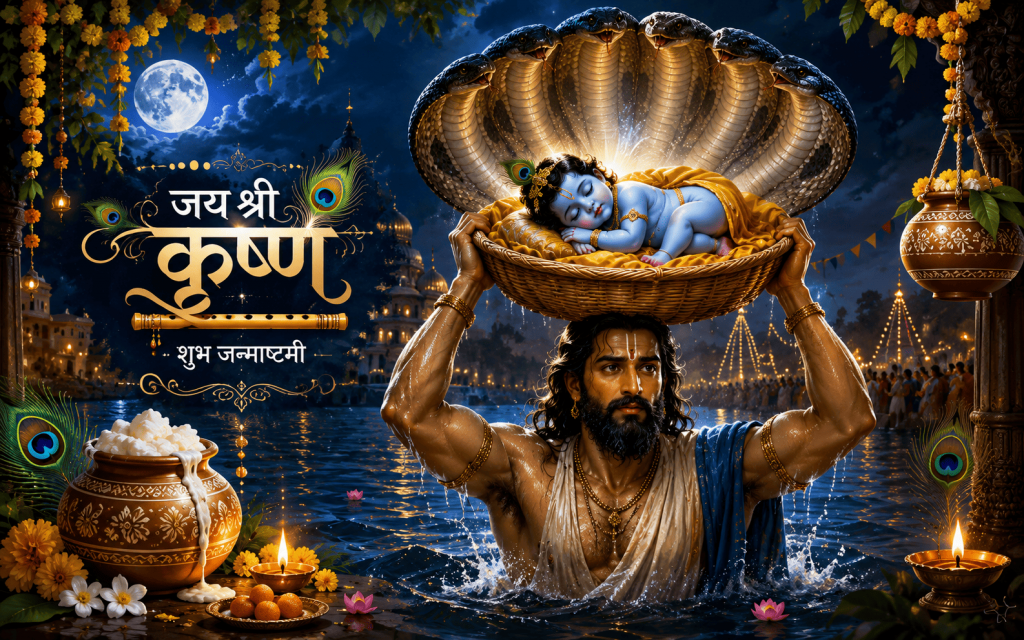
As Vasudeva carried baby Krishna in a woven basket, the Yamuna River made way, while Lord Sheshnag protected the child from the rain. After reaching Gokul, Vasudeva exchanged Krishna with the newborn daughter of Mother Yashoda and safely returned to the prison.
When Kansa tried to kill the infant, she transformed into Goddess Yogmaya and warned him that his destroyer had already been born elsewhere. Therefore, Kansa ordered a kingdom-wide search, but Lord Krishna remained safe in Gokul under the care of Nanda Baba and Mother Yashoda, and thus his divine mission began.

Lord Krishna’s Childhood in Gokul
Nanda Baba and Mother Yashoda raised Lord Krishna in Gokul. The village soon became a place of divine joy. Every resident loved the little child. His smile filled every home with happiness.
Krishna spent his early years among cows, calves, rivers, forests, and friends. His simple childhood reflected purity, innocence, and compassion. Devotees still remember those moments through Bhajans, paintings, and temple festivals.
Children knew him by many names.
- Kanha
- Gopal
- Govinda
- Kanhaiya
- Makhan Chor
- Murli Manohar
Each name reflects a different form of Lord Krishna.
The Story of Makhan Chor
Lord Krishna loved butter.
The Gopis stored butter inside hanging pots. Krishna gathered his friends and formed small human pyramids. One child climbed onto another’s shoulders. Krishna reached the pot and shared the butter with everyone.
The Gopis often complained to Mother Yashoda.
Yashoda smiled at their stories. She knew Krishna’s playful nature.
Devotees see a deeper meaning in this pastime. Butter represents a pure heart. Lord Krishna accepts the love of every devotee whose heart remains free from pride.
Putana Vadh
King Kansa never stopped searching for the child mentioned in the prophecy.
He sent many demons to Gokul.
Putana arrived first.
She disguised herself as a beautiful woman. Poison covered her body. Her plan focused on killing the infant Krishna.
She entered Nanda Baba’s house without fear.
Putana lifted baby Krishna into her arms.
Krishna recognized her true nature.
He drank her life force instead of the poison.
Putana fell to the ground in her original gigantic form.
The people of Gokul praised Lord Krishna for protecting the village.
Kaliya Mardan
The Yamuna River once became poisonous because of the serpent Kaliya.
People feared the river.
Animals died after drinking the water.
Krishna entered the river without hesitation.
A fierce battle followed.
Krishna climbed onto Kaliya’s many hoods. He danced upon them until the serpent surrendered.
Kaliya accepted defeat.
Krishna spared his life.
The serpent left the Yamuna forever.
The river became clean once again.
This story teaches the victory of purity over arrogance.
Govardhan Leela
The people of Gokul worshipped Lord Indra every year.
Krishna encouraged the villagers to honor Govardhan Hill, cows, nature, and hard work.
Indra became angry.
Heavy rain covered Gokul.
Floodwater spread across the village.
Krishna lifted Govardhan Hill with the little finger of his left hand.
The villagers gathered beneath the hill.
No one suffered harm.
The storm ended after seven days.
Indra realized his mistake.
He bowed before Lord Krishna.
Govardhan Puja continues to celebrate this divine event.
Krishna Defeats King Kansa
Krishna grew into a brave young man.
Akrura arrived in Gokul with an invitation from King Kansa.
The king organized a wrestling competition in Mathura.
His real plan focused on killing Krishna.
Krishna accepted the invitation.
He entered Mathura with Balarama.
The royal elephant Kuvalayapida blocked the entrance.
Krishna defeated the elephant.
The wrestling arena welcomed Chanura and Mushtika.
Both wrestlers challenged Krishna and Balarama.
The battle ended quickly.
Krishna entered Kansa’s royal court.
He pulled Kansa from the throne.
A fierce battle followed.
Krishna defeated Kansa.
Mathura became free once again.
King Ugrasena returned to the throne.
Devaki and Vasudeva regained their freedom.
The prophecy reached its completion.
Spiritual Significance of Krishna Janmashtami
Krishna Janmashtami carries a timeless spiritual message.
Lord Krishna represents Dharma.
His life teaches courage during difficult times.
His teachings encourage selfless action.
The Bhagavad Gita explains the importance of duty, devotion, discipline, and faith.
Every devotee finds inspiration in those teachings.
The festival encourages spiritual growth through simple practices.
- Prayer
- Meditation
- Charity
- Compassion
- Truthfulness
- Self-control
- Service
- Devotion
These values shape a meaningful life.
Importance of Krishna Janmashtami
Krishna Janmashtami is not limited to one celebration.
The festival encourages personal transformation.
Devotees reflect on their thoughts, actions, and responsibilities.
Many people read the Bhagavad Gita on this day.
Many families organize Bhajan evenings.
Children learn stories from the Bhagavata Purana.
Temples conduct spiritual discourses.
Every activity strengthens devotion.
Krishna Janmashtami Vrat
The Janmashtami Vrat holds great importance in Hindu tradition.
Many devotees observe a complete fast from sunrise until midnight.
Some devotees choose a fruit-based fast.
Some consume milk and vrat-friendly food.
Family traditions often determine the method.
The purpose remains the same.
Complete devotion to Lord Krishna.
Rules for Krishna Janmashtami Vrat
Devotees prepare themselves before beginning the fast.
Common Practices
- Wake up before sunrise.
- Take a bath.
- Wear clean clothes.
- Clean the Puja room.
- Install the idol of Laddu Gopal.
- Take a Sankalp for the Vrat.
- Spend time in prayer.
- Chant Krishna mantras.
- Read the Bhagavad Gita.
- Visit a nearby temple.
Foods Allowed During the Fast
Many devotees eat simple vrat food.
Popular choices include:
- Fruits
- Milk
- Yogurt
- Makhana
- Coconut water
- Dry fruits
- Sabudana Khichdi
- Sama rice
- Singhara flour
- Rajgira flour
- Peanuts
Many families avoid heavy meals until midnight.
Foods to Avoid
Traditional Janmashtami fasting excludes several foods.
Most devotees avoid:
- Rice
- Wheat
- Regular flour
- Onion
- Garlic
- Meat
- Eggs
- Alcohol
- Tobacco
The fast encourages simplicity and discipline.
Benefits of Janmashtami Vrat
The Vrat strengthens devotion.
The day creates time for prayer and self-reflection.
Many devotees experience greater mental peace.
Many people use the day to reduce worldly distractions.
The festival encourages gratitude, patience, and compassion.
These values remain important throughout life.

Krishna Janmashtami Puja Samagri
Collect the Puja items before the worship begins. A complete Puja Thali helps devotees perform every ritual with focus.
Essential Puja Items
- Idol or picture of Laddu Gopal
- Wooden chowki
- Yellow or red cloth
- Peacock feather
- Flute
- Tulsi leaves
- Panchamrit
- Gangajal
- Kumkum
- Chandan
- Akshat (Rice)
- Fresh flowers
- Garland
- Incense sticks
- Camphor
- Ghee lamp
- Cotton wicks
- Bell
- Conch shell
- Butter (Makhan)
- Mishri
- Fresh fruits
- Dry fruits
- Sweets
- New clothes for Laddu Gopal
- Decorative cradle (Jhula)
Many families create tiny footprints from the entrance of the house to the Puja room. The footprints symbolize the arrival of Lord Krishna.
Krishna Janmashtami Puja Vidhi
The main Puja takes place during Nishita Kaal. Devotees perform every step with devotion and concentration.
Step 1: Prepare the Puja Place
Clean the worship area.
Spread a clean cloth over the chowki.
Place the idol of Laddu Gopal on the decorated seat.
Decorate the area with flowers and diyas.
Step 2: Decorate Laddu Gopal
Dress Lord Krishna in fresh clothes.
Adorn the idol with ornaments.
Place a peacock feather on the crown.
Keep a small flute beside the idol.
Arrange the decorated cradle near the idol.
Step 3: Light the Diya
Light a ghee lamp.
Light incense sticks.
Offer a short prayer to Lord Ganesha.
Pray for wisdom and peace.
Step 4: Perform Abhishek
Prepare Panchamrit using:
- Milk
- Curd
- Honey
- Ghee
- Sugar
Offer Abhishek with:
- Gangajal
- Milk
- Panchamrit
- Clean water
Dry the idol carefully.
Dress the idol again.
Step 5: Apply Tilak
Apply Chandan.
Apply Kumkum.
Offer Akshat.
Offer flowers.
Place Tulsi leaves near the Bhog.
Tulsi holds great importance in Krishna worship. Devotees consider every offering incomplete without Tulsi.
Step 6: Offer Bhog
Offer Lord Krishna’s favorite foods.
Popular Bhog includes:
- Makhan
- Mishri
- Panchamrit
- Kheer
- Peda
- Panjiri
- Fruits
- Dry fruits
Many temples prepare Chappan Bhog, a grand offering of fifty-six food items.
Step 7: Chant Krishna Mantras
Many devotees chant sacred mantras throughout the Puja.
Om Namo Bhagavate Vasudevaya
ॐ नमो भगवते वासुदेवाय
This mantra expresses devotion to Lord Krishna.
Hare Krishna Mahamantra
Hare Krishna Hare Krishna
Krishna Krishna Hare Hare
Hare Rama Hare Rama
Rama Rama Hare Hare
This Mahamantra remains one of the most widely chanted prayers in the Vaishnava tradition.
Step 8: Perform Krishna Aarti
Perform the Aarti with family members.
Ring the bell.
Blow the conch shell.
Sing devotional songs.
Offer flowers.
Offer prayers for peace and prosperity.
Step 9: Celebrate the Divine Birth
Midnight marks the birth of Lord Krishna.
Ring bells across the home.
Gently swing the cradle of Laddu Gopal.
Distribute Prasad among family members.
Break the fast after completing the Puja.
Krishna Janmashtami Rituals
Every ritual reflects devotion toward Lord Krishna.
Common traditions include:
- Day-long fasting
- Midnight worship
- Decorating Laddu Gopal
- Jhulan Seva
- Reading the Bhagavad Gita
- Singing Bhajans
- Chanting Krishna Mantras
- Krishna Leela performances
- Temple visits
- Charity
- Feeding cows
- Prasad distribution
Many families organize devotional gatherings at home.
Children dress as Lord Krishna and Radha during cultural programs.
Dahi Handi Celebration
Dahi Handi takes place one day after Krishna Janmashtami in many parts of India.
The celebration remembers Krishna’s childhood pastime of stealing butter.
An earthen pot filled with butter, curd, or sweets hangs at a great height.
Groups known as Govindas form human pyramids.
One participant climbs to the top.
The pot breaks amid cheers and devotional music.
Mumbai, Thane, Pune, and Nashik host some of India’s largest Dahi Handi celebrations.
ISKCON Janmashtami Celebrations
ISKCON temples celebrate Janmashtami with great devotion.
The festival begins early in the morning.
Programs continue until midnight.
Visitors take part in:
- Mangala Aarti
- Bhagavad Gita discourses
- Harinam Sankirtan
- Abhishek
- Bhajan sessions
- Cultural performances
- Midnight Maha Aarti
- Chappan Bhog Darshan
- Prasad distribution
ISKCON temples in Vrindavan, Mayapur, Delhi, Mumbai, Bengaluru, London, and New York welcome thousands of devotees every year.
Regional Celebrations Across India
Mathura
Mathura is the birthplace of Lord Krishna.
Krishna Janmabhoomi Temple hosts grand celebrations.
Pilgrims arrive from different parts of India.
The temple remains open throughout the night.
Vrindavan
Vrindavan celebrates the festival with Ras Leela performances, flower decorations, devotional music, and temple processions.
Banke Bihari Temple attracts thousands of devotees.
Dwarka
Dwarkadhish Temple organizes special Puja ceremonies.
The city celebrates Lord Krishna as the king of Dwarka.
Maharashtra
Dahi Handi remains the main attraction.
Large teams compete to break the hanging pot.
Music and cultural performances continue throughout the day.
Gujarat
Temples organize Bhajans, Garba, and Krishna Leela.
Families prepare traditional sweets and festive meals.
South India
Many families decorate their homes with rice flour footprints that symbolize Baby Krishna entering the house.
Children dress as Krishna and Radha during community celebrations.
Dos and Don’ts
Dos
- Wake up early.
- Wear clean traditional clothes.
- Observe the Vrat with devotion.
- Offer Tulsi leaves.
- Read the Bhagavad Gita.
- Chant Krishna Mantras.
- Feed cows.
- Donate food or clothes.
- Respect family traditions.
- Distribute Prasad.
Don’ts
- Consume onion or garlic during the Vrat.
- Drink alcohol.
- Smoke.
- Waste food.
- Speak harshly.
- Hurt animals.
- Break the fast before the midnight Puja if you have chosen a full-day Vrat.
Frequently Asked Questions
When is Krishna Janmashtami in 2026?
Krishna Janmashtami falls on Friday, September 4, 2026.
Why does the Puja take place at midnight?
Hindu scriptures describe midnight as the birth time of Lord Krishna.
Is fasting compulsory?
No. Devotees may choose the type of fast according to their health, age, and family tradition.
Which Bhog does Lord Krishna like?
Makhan, Mishri, Panchamrit, Kheer, Panjiri, fresh fruits, and Tulsi leaves are among the most popular offerings.
Why are Tulsi leaves important?
Tulsi holds a sacred place in Vaishnava tradition. Devotees offer Tulsi leaves with Bhog as a mark of devotion to Lord Krishna.
Where did Lord Krishna take birth?
Lord Krishna was born inside the prison of King Kansa in Mathura, Uttar Pradesh.
What does Dahi Handi represent?
Dahi Handi celebrates the playful childhood of Lord Krishna and his love for butter.
Conclusion
Krishna Janmashtami celebrates the birth of a divine teacher whose message continues to guide humanity. Lord Krishna’s life reflects courage, wisdom, compassion, humility, and devotion. His teachings in the Bhagavad Gita remain relevant in every age.
The festival brings families together through prayer, fasting, Bhajans, and midnight worship. Every ritual reminds devotees of the victory of Dharma over Adharma. Every chant fills the heart with devotion.
Celebrate Krishna Janmashtami 2026 with sincerity, gratitude, and devotion. Offer your prayers with a pure heart. Follow the path shown by Lord Krishna. May Laddu Gopal bless your home with peace, happiness, good health, prosperity, and spiritual growth.
Jai Shri Krishna! 🙏🌺